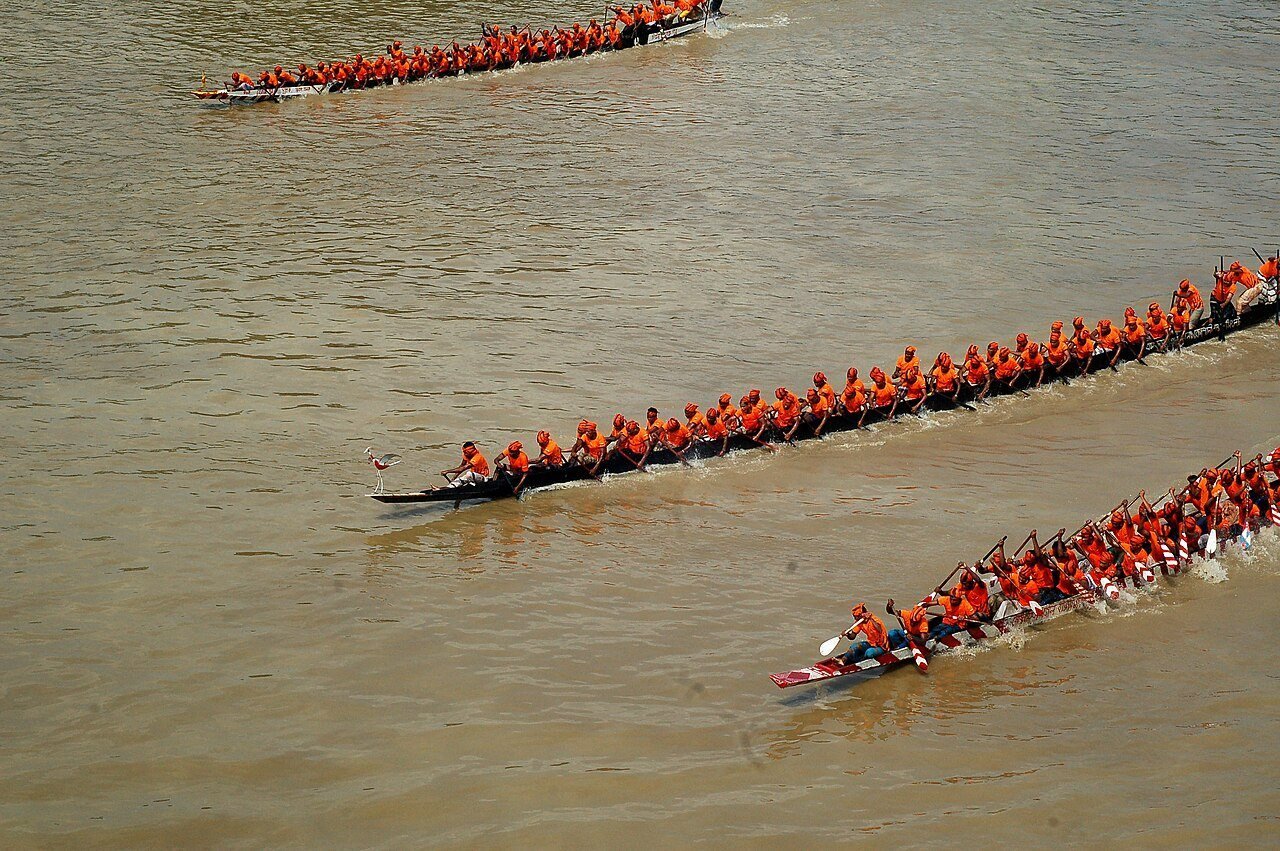
When long racing boats cut through the Dhaleshwari at Munshiganj, the sound that carries to the riverbank is not only the splash of oars. It is the singing of the rowers. These songs, known as sari gaan (also written shari gan), are among the oldest working songs of Bengal.
Songs of work
Sari gaan grew out of working communities, especially boatmen and labourers, in what is now Bangladesh and the Indian state of West Bengal. The songs kept people moving together while they rowed, hauled or worked in groups, so their strong, regular beat matters as much as their words. They are usually sung in a lead and chorus pattern: one voice sets the line and the crew answers.
Sari gaan is often confused with bhatiali, another river song of Bengal. They are different forms. Bhatiali takes its name from bhata, the ebbing tide, and was sung by boatmen drifting downstream. It is slow and reflective and is associated with the Mymensingh region along the Brahmaputra. Sari gaan, by contrast, is a song of effort and teamwork, and it is closely tied to the nouka baich, or boat race.
The boat race season
Nouka baich is a traditional paddling race. Crews can range from seven to around one hundred rowers, and motor boats are not allowed. Races are held in the wet and autumn seasons, roughly June to October, after the monsoon rains fill the rivers. Different regions use different boats: narrow wooden koshas in Mymensingh, Pabna and Dhaka, and goyna boats around Dhaka.
The races became popular in towns in the eighteenth century, when Nawab families organised them. Historically, cymbals were sometimes played alongside the singing, which helped crews keep time.
On the Dhaleshwari
In Munshiganj, a traditional boat race is held every year on the Dhaleshwari River. The course runs for about three kilometres from Mirkadim municipality to the Munshiganj launch terminal. Boats with crews of 25, 50 and 60 oarsmen take part, and thousands of people line the banks to watch.
The tradition has also travelled with the diaspora. British Bangladeshis held the first nouka baich in the United Kingdom in Oxford in 2007, and the event later moved to Birmingham in 2015.
For many people in Bikrampur, these songs and races are a link between the river, the season and the community. Each year the rowers' chorus on the Dhaleshwari keeps an old form of Bengali music in use.
Sources: en.wikipedia.org, en.wikipedia.org, en.wikipedia.org, en.wikipedia.org